Quick Answer
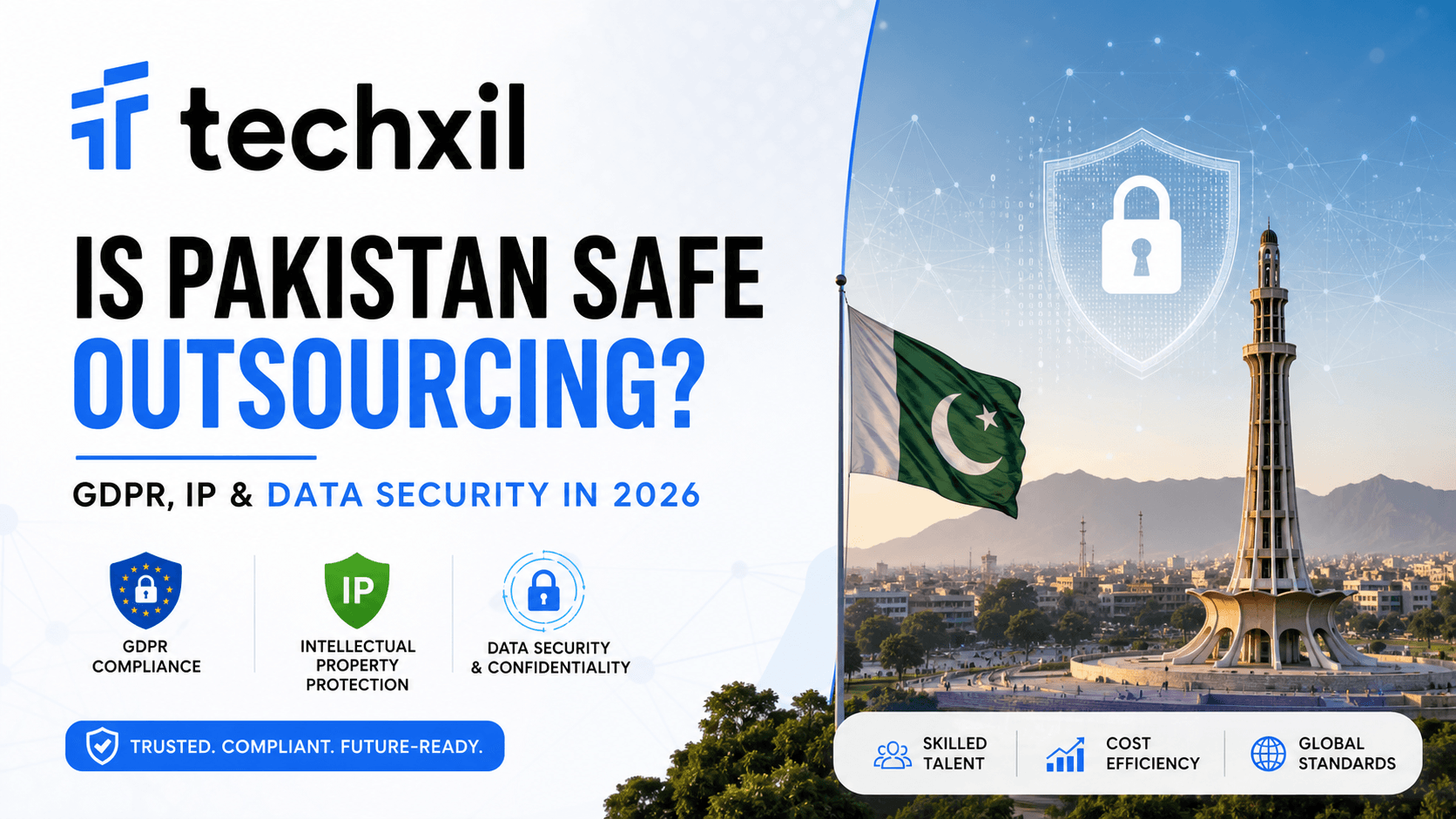
Yes, outsourcing to Pakistan can be fully GDPR-compliant — the mechanism is Standard Contractual Clauses (SCCs) in a Data Processing Agreement, not the vendor's country having EU "adequacy" status, and this is the same mechanism used for any non-adequate country. IP protection comes from an assignment clause in the Master Services Agreement, not from which country's copyright law applies. The real risk factors are the same as with any offshore vendor — contract quality and vendor process discipline — and both are fully within a European buyer's control to vet before signing.
The Question Behind the Question
"Is Pakistan safe for outsourcing" usually isn't one question — it's three: is this legally compliant for my business, is my intellectual property protected, and is this vendor's operational security good enough. Each has a specific, factual answer that doesn't depend on vague reassurance, and each is worth taking seriously rather than dismissing or over-worrying about.
GDPR: How Compliance Actually Works
This is the most misunderstood part of outsourcing to any non-EU country, not just Pakistan. The common (incorrect) assumption is that GDPR compliance requires the vendor's country to have an EU "adequacy decision" — official recognition that a country's data protection laws are equivalent to the EU's. Pakistan does not have adequacy status. Neither do the US, India, or most countries European companies already outsource to.
The actual compliance mechanism is contractual, not geographic: Standard Contractual Clauses (SCCs), built into a Data Processing Agreement (DPA) between your company and the vendor. SCCs are pre-approved contract clauses published by the European Commission specifically to enable lawful data transfers to non-adequate countries. Sign a proper DPA with SCCs, and the outsourcing relationship is compliant — the vendor's country of operation doesn't change that.
What genuinely differs with a non-EU vendor is enforcement: an EU-based vendor is directly subject to GDPR and its regulators, while a non-EU vendor is bound only by what's in the contract. This makes two things matter more, not impossible: the actual quality of the DPA (specific, not boilerplate), and data minimisation — giving the vendor access only to what a task genuinely requires, using anonymised or synthetic data for development and testing wherever real user data isn't strictly necessary.
A Practical GDPR Checklist
- Sign a DPA with SCCs before any data access begins — not after.
- Scope data access to what the task requires; use anonymised/test data for development environments where possible.
- Confirm sub-processor terms if the vendor uses any third-party tools that touch your data (e.g. cloud hosting, analytics).
- Define a data breach notification clause with a specific timeframe (GDPR requires notifying authorities within 72 hours — your contract with the vendor should require them to notify you fast enough to meet that).
IP Protection: How Ownership Actually Transfers
The second common misconception: that intellectual property protection depends on which country's copyright law governs the work. It doesn't — it depends on the contract. A properly drafted Master Services Agreement (MSA) includes an explicit IP assignment clause: all code, designs, and deliverables created under the engagement are assigned — meaning ownership transfers — to the client, typically upon payment.
This is standard practice for any outsourcing relationship anywhere, and it's worth being specific about the difference between assignment and licensing: a license means the vendor retains ownership and grants you rights to use the work; assignment means you own it outright. Insist on assignment language, not a license, and insist on it before work begins, not after a dispute arises.
Beyond the MSA's core assignment clause, a solid contract also covers: a confidentiality/NDA clause protecting your business information beyond just the code itself, and — where relevant — an explicit statement that the vendor won't reuse your proprietary code or designs in other client work.
Infrastructure and Operational Reliability
A dated but still common concern is Pakistan's national infrastructure — internet reliability, power stability. This mattered more a decade ago; established software houses working with international clients today operate from modern offices with redundant connections, and critically, the actual work product (code, deployments, CI/CD) lives on the same cloud infrastructure — AWS, GCP, Azure — that any distributed team anywhere uses. A local outage doesn't touch code already pushed to a remote repository or a deployment pipeline already running in the cloud. The more relevant question when vetting a vendor is their internal process discipline: do they use version control properly, do they have backup and access-control practices, not the state of the local grid.
How to Vet a Vendor's Security Practices
Concrete questions to ask before signing, not generic certifications to look for:
- Do they enforce role-based access control on client repositories and systems?
- Do they have a written data-handling policy they can share, not just claim to have?
- Will they sign an NDA and DPA before any data access, not after work has started?
- Do they use encrypted connections and a password manager for shared credentials, rather than plaintext sharing over chat or email?
- Can they name a client reference who can speak to how a real security or access issue was actually handled?
A vendor's willingness to answer these specifically — and put the answers in the contract — is a far stronger signal than any badge or certification claim on their website.
Legal Recourse If Something Goes Wrong
This should be settled in the contract before work starts, not discovered during a dispute. Most cross-border service agreements specify a governing law and jurisdiction (commonly the client's country, or a neutral third option) and a defined dispute-resolution process — typically direct negotiation first, then mediation, then arbitration as a last resort. A vendor with genuine international client experience will usually already have standard language for this; treat hesitation on this point as a real signal, not an unusual ask on your part.
How Techxil Handles This in Practice
Techxil works under signed NDAs and DPAs with international clients as standard practice, not as a special accommodation — see our own Privacy Policy for how we handle data internally. For more on our company and how we operate, see About Techxil. If you've already read our broader case for why Pakistan is a strong outsourcing destination and this is the follow-up question — the compliance and risk specifics — a scoping call is the fastest way to get a concrete answer for your specific data-handling situation, not a generic one.
Key Takeaways
- GDPR compliance depends on the contract (SCCs + DPA), not the vendor's country having EU adequacy status — the same mechanism used for the US, India, and most outsourcing destinations.
- IP ownership transfers through an assignment clause in the MSA, not through which country's copyright law applies — insist on assignment, not a license.
- Modern Pakistani software houses run on the same cloud infrastructure as any distributed team; local infrastructure concerns are largely outdated.
- Vet security practices with specific questions (access control, NDA/DPA timing, breach notification), not generic certification claims.
- Settle governing law and dispute resolution in the contract before work starts.
Frequently Asked Questions
Can a European company be GDPR-compliant while outsourcing to a vendor in Pakistan?
Yes. Compliance is achieved through SCCs in a Data Processing Agreement — the same mechanism used for any non-adequate country, not through the vendor's country having EU adequacy status.
What's actually different about GDPR risk with a Pakistani vendor versus an EU-based one?
The mechanism is identical, but an EU-based vendor is directly subject to GDPR enforcement while a non-EU vendor is bound only by contract — making DPA quality and data minimisation more important, not making compliance impossible.
How is intellectual property actually protected when a Pakistani vendor writes your code?
Through an IP assignment clause in the MSA that transfers ownership to you upon payment — not through which country's default copyright law applies.
Is Pakistan's IT infrastructure reliable enough for serious development work?
Yes — established vendors operate from modern offices and rely on the same cloud infrastructure (AWS, GCP, Azure) as any distributed team, so the work product doesn't depend on local infrastructure the way it once did.
How do I vet a Pakistani vendor's security practices before signing?
Ask about access control, written data-handling policies, NDA/DPA timing, credential management, and request a client reference who can speak to a real security incident being handled.
What happens if a dispute arises — what legal recourse does a European company have?
This should be defined in the contract upfront: governing law, jurisdiction, and a dispute-resolution process (negotiation, mediation, arbitration).

Senior Product & SaaS Product Designer · 9+ years · Dubai, UAE
Adil transforms complex problems into clean, intuitive digital experiences. With expertise spanning FinTech, SaaS, and B2B platforms across 5+ industries, he writes about product design, digital strategy, and the technology landscape shaping South Asia's growing tech economy.