Quick Answer
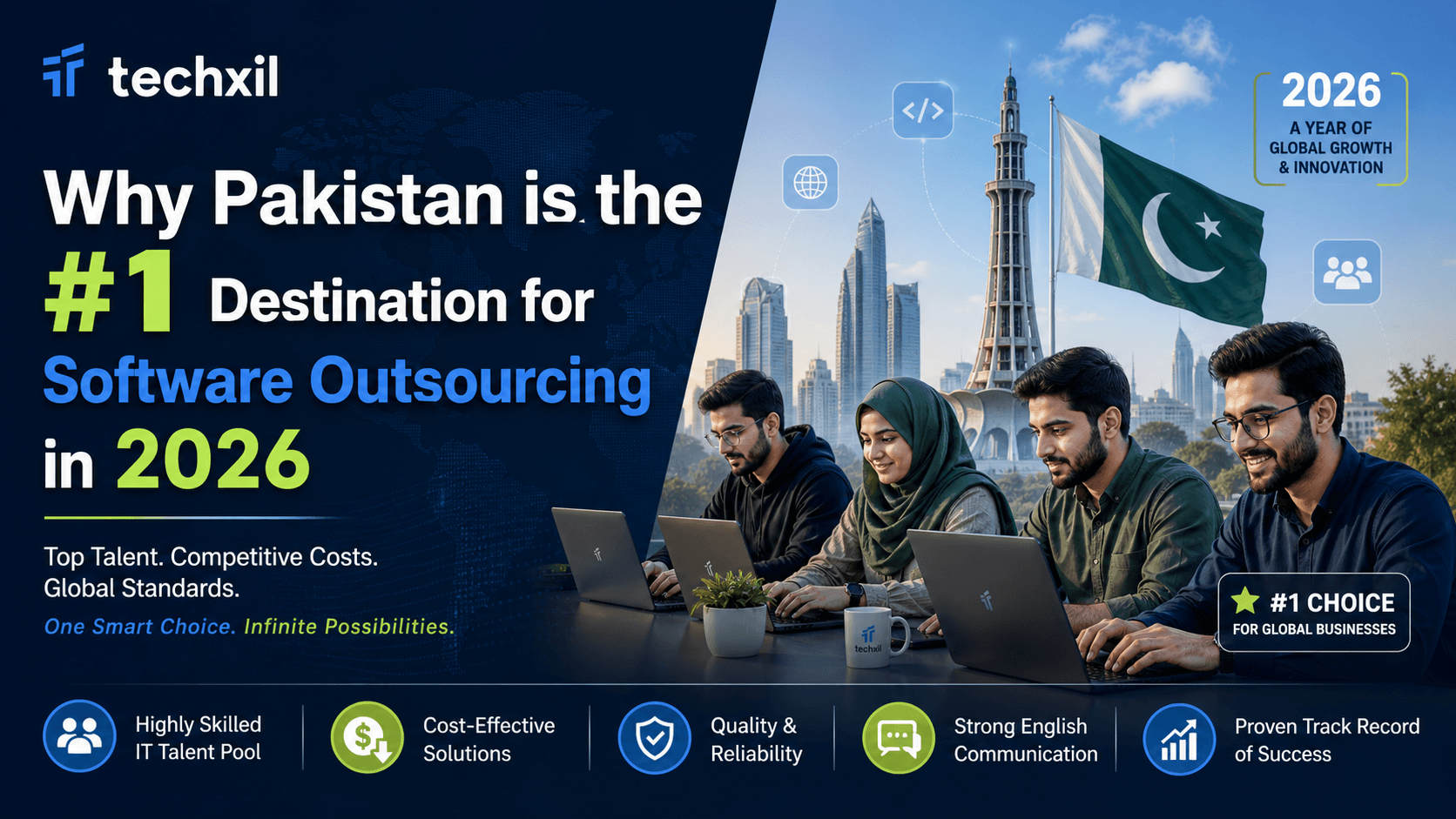
Pakistan is the #1 software outsourcing destination in 2026 because of its 300,000+ English-speaking IT workforce, highly competitive $15–$30/hr developer rates (70% cheaper than the West), $4.5B+ annual IT exports growing at 17% CAGR, and a government-backed ecosystem of 20,700+ PSEB-registered companies. No other emerging market combines this cost advantage with this depth of technical talent.
Pakistan's IT Industry at a Glance
Pakistan's software outsourcing sector has undergone a dramatic transformation over the last decade. What was once a fragmented collection of small agencies has become a globally recognised, government-backed industry generating over $4.5 billion in IT exports annually — with the State Bank of Pakistan recording a single-month record of $437 million in December 2025.
The numbers tell the story clearly. Pakistan's IT exports grew 21–33% year-over-year in recent reporting periods. The workforce now exceeds 300,000 IT professionals, with 25,000–30,000 new computing graduates entering the market annually. Over 20,700 companies are formally registered with the Pakistan Software Export Board (PSEB) — a figure that doubles as both a quality signal and a vendor base that gives international clients genuine choice.
The global demand for cost-effective, high-quality software development has never been higher. US companies facing $100–$200+/hr domestic developer rates are increasingly looking at Pakistan — and what they find is not a compromise, but a competitive upgrade.
| Metric | Value |
|---|---|
| Annual IT Exports | $4.5B+ |
| Monthly Record (Dec 2025) | $437M |
| Year-over-Year Growth | 21–33% |
| IT Workforce | 300,000+ |
| New Graduates/Year | 25,000–30,000 |
| PSEB-Registered Companies | 20,700+ |
| Average Hourly Rate | $15–$30 |
| Cost Savings vs US | Up to 70% |
| IT Export CAGR | 17% |
| English-Speaking Population Rank | 3rd Largest Globally |
Sources: State Bank of Pakistan (SBP), Pakistan Software Export Board (PSEB), Express Tribune, Business Recorder
7 Reasons Pakistan Leads Global Software Outsourcing in 2026
1. Unbeatable Cost Advantage
The most immediate driver for any outsourcing decision is cost — and Pakistan wins decisively. Mid-level Pakistani developers charge $15–$30 per hour, compared to $100–$200+ in the United States and $45–$80 in Eastern Europe. Senior architects and full-stack specialists command $30–$60/hour — still a fraction of Western rates.
In practical terms: a 6-month product build that costs $300,000–$500,000 in the US costs $75,000–$150,000 with a senior Pakistani team — without sacrificing quality. This is not a race to the bottom. Pakistan's cost advantage is structural, driven by living costs and currency, not by lower skill levels. The same engineering competencies that command $120/hr in San Francisco cost $25/hr in Karachi.
2. Deep and Growing Talent Pool
Pakistan produces 25,000–30,000 computing graduates annually from universities including FAST-NUCES, LUMS, NUST, Comsats, and UET — institutions with rigorous CS and engineering programmes. The country's total IT workforce has crossed 300,000 professionals and is on track to reach 500,000 by 2030 under the government's IT growth initiatives.
Pakistani developers demonstrate strong competency across the full modern technology stack: React, Node.js, Python, Django, Laravel, Flutter, React Native, AWS, Azure, GCP, Docker, Kubernetes, and increasingly — AI/ML frameworks including TensorFlow, PyTorch, and LangChain. The depth of specialisation available in Karachi, Lahore, and Islamabad rivals many European tech hubs.
3. High English Proficiency
Communication is where many outsourcing engagements fail — and Pakistan addresses this structurally. English is Pakistan's official language for business, government, law, and education. Pakistan is the 3rd largest English-speaking country in the world by population. University instruction in computing is conducted entirely in English. Technical documentation, code comments, and client-facing communication are English by default — not by exception.
This matters enormously in practice. Misunderstood requirements, unclear status updates, and communication breakdowns account for the majority of failed outsourcing engagements globally. Pakistani developers can participate meaningfully in product discussions, not just execute specifications handed to them.
4. Government Support Through PSEB
Pakistan's federal government has made IT exports a national priority. The Pakistan Software Export Board (PSEB) provides a formal registration and support framework for IT companies, including tax exemptions on IT exports, subsidised office space through technology parks, facilitated banking channels for foreign currency receipts, and international marketing support for Pakistani software companies.
For international clients, PSEB registration is a meaningful quality signal. It indicates that the company is formally incorporated, tax-compliant, and eligible for Pakistan's IT export support programmes. It is a baseline check — not a complete due-diligence substitute, but an important first filter when shortlisting vendors.
5. Full-Stack Capabilities Across Domains
Pakistan's software industry covers the complete development lifecycle. International clients can source not just developers, but product managers, UI/UX designers, QA engineers, DevOps specialists, and business analysts — all in one engagement. This eliminates the coordination overhead of managing multiple vendors across different countries for different roles.
Pakistani software houses have demonstrated capability across high-complexity domains: core banking systems, healthcare EMR platforms, logistics management software, e-commerce platforms handling millions of transactions, and AI-integrated SaaS products. The ecosystem has matured from basic web development to genuinely complex enterprise software delivery.
6. Strong Adoption of AI and Emerging Technologies
Pakistan's developer community has rapidly adopted AI development tools and frameworks. Pakistani companies now offer AI-integrated custom software, LLM-powered chatbots, predictive analytics platforms, and machine learning model deployment — not just as experiments, but as production-grade deliverables.
The country's large pool of mathematics and statistics graduates feeds directly into AI/ML engineering. Pakistani data scientists have competed — and won — in global AI competitions including Kaggle challenges. International companies building AI-enhanced products increasingly see Pakistan as the go-to partner for cost-effective AI development work.
7. Proven Track Record with Global Clients
Pakistan's software industry is no longer in its proving phase. Pakistani companies have delivered software for clients in the US, UK, UAE, Canada, Australia, Germany, and across Southeast Asia. Clutch.co, GoodFirms, and AppFutura feature hundreds of verified reviews from international clients who have worked with Pakistani software houses on projects ranging from $10,000 startups to $2M+ enterprise rollouts.
This track record creates a virtuous cycle: experienced clients return for new projects, providing references that help the next international client gain confidence. Pakistan's reputation in the global outsourcing market has crossed from "emerging" to "established."
Pakistan vs India vs Eastern Europe: The Honest Comparison
| Factor | Pakistan | India | Eastern Europe |
|---|---|---|---|
| Hourly Rate | $15–$30 | $20–$45 | $45–$80 |
| English Proficiency | Very High | High | Moderate–High |
| Talent Pool | 300K+ | 5.4M+ | 1.2M+ |
| IT Export Growth | 17% CAGR | 8–10% CAGR | 6–9% CAGR |
| Timezone (UTC) | UTC+5 | UTC+5:30 | UTC+1 to +3 |
| Govt Support | PSEB + Tax Exemptions | NASSCOM | Varies by country |
| Cost Savings vs US | 60–80% | 50–70% | 30–50% |
| AI/Emerging Tech | Rapidly growing | Mature | Strong |
India remains the global market leader by volume — but Pakistani software houses increasingly win on value. Eastern Europe offers proximity to European clients but at rates 3–4x higher than Pakistan. For cost-conscious businesses that need quality and communication, Pakistan sits in the optimal position.
How to Choose the Right Pakistani Software House: 7-Step Checklist
Not every Pakistani IT company is equal. Here is the process Techxil recommends when evaluating any outsourcing partner — including us.
- Define your project scope clearly — Document functional requirements, technical constraints, timeline, and budget range before reaching out to any vendor. A clear brief gets accurate proposals and prevents scope creep.
- Filter for PSEB-registered companies — PSEB registration signals formal oversight, tax compliance, and eligibility for Pakistan's IT export support programmes. It is a baseline quality filter.
- Review portfolios and case studies — Look for companies that have shipped products similar to yours. Genuine case studies show before/after outcomes, technologies used, and team structure — not just screenshots.
- Check independent client references — Request references you can contact directly. Cross-check on Clutch.co, GoodFirms, and Google reviews for independent validation. Look for patterns across multiple reviews.
- Assess communication on a video call — Schedule a call with the actual team who will work on your project. Evaluate technical depth, English fluency, and whether they ask smart questions about your requirements.
- Start with a paid discovery sprint — Commission a 1–2 week paid discovery or trial module before committing to a full engagement. This reveals work quality and communication style with minimal budget risk.
- Structure clear contracts and IP ownership — Ensure your contract explicitly covers IP assignment, NDA terms, source code ownership on final payment, confidentiality, milestone-based payments, and dispute resolution.
How Techxil Fits Into This Picture
Techxil is a PSEB-registered software development company based in Karachi, Pakistan. We build custom software, web applications, mobile apps, AI-integrated systems, and startup MVPs for clients in the UK, UAE, North America, and beyond.
What differentiates Techxil is a product-thinking approach. We treat every client project as a product — not a task list. That means our team includes not just engineers, but UX designers and product strategists who ensure that what we build actually solves your users' problems. We work in transparent agile sprints using Jira and GitHub, maintain daily async communication via Slack, and provide full IP ownership to clients upon final payment.
Our Core Services
- Enterprise Software Development — Bespoke web applications, enterprise platforms, SaaS products built to your exact specifications.
- Web Development — Full-stack web development using React, Next.js, Laravel, Django, and WordPress at scale.
- Mobile App Development — Native iOS and Android apps, or cross-platform with Flutter and React Native.
- AI & Automation — LLM integrations, custom AI tools, workflow automation, and predictive analytics dashboards.
- Startup MVP Development — Fast, focused MVPs in 6–12 weeks to validate your idea with real users and investors.
Key Takeaways
- Pakistan's IT exports exceed $4.5B annually, growing at 17% CAGR — the fastest in the region.
- Developers cost $15–$30/hr, delivering 60–80% savings compared to US rates without sacrificing quality.
- 300,000+ IT professionals and 25,000–30,000 new graduates per year ensure supply keeps pace with demand.
- English is the official business language — communication challenges that plague other outsourcing destinations are structurally mitigated in Pakistan.
- PSEB provides a formal government-backed quality framework that gives international clients a baseline assurance layer.
- Pakistan's growing AI capability means you can source AI-integrated development work — not just traditional software — at competitive rates.
- Due diligence matters: shortlist PSEB-registered companies, verify reviews independently, and always start with a scoped trial before full commitment.
Go Deeper: A European Buyer's Guide
If you're evaluating Pakistan specifically from Europe, three follow-up guides go deeper on the practical questions this overview doesn't fully cover:
- How European Companies Hire Dedicated Developers in Pakistan — engagement models, the real timezone overlap with UK/CET, and a step-by-step hiring process.
- Software Development Cost: Pakistan vs. Eastern Europe — real hourly and monthly rate comparisons against Poland, Romania, and Ukraine, not just the US.
- Is It Safe to Outsource to Pakistan? GDPR, IP & Risk Guide — the direct, specific answer to the GDPR and IP protection questions most European buyers ask before signing.
Frequently Asked Questions
Is it safe to outsource software development to Pakistan?
Yes. Over 20,700 PSEB-registered companies operate under formal government oversight. Pakistan has IP protection legislation including the Copyright Ordinance and PECA 2016. Many Pakistani software houses have delivered for Fortune 500 clients and hold ISO 9001 and CMMI certifications. Use clear contracts with NDA, IP assignment, and milestone-based payments.
How much does software outsourcing to Pakistan cost?
Mid-level Pakistani developers charge $15–$30/hour; senior specialists charge $30–$60/hour. This is 60–80% lower than US rates ($100–$200+/hr). A full-stack web application costing $100,000 in the US typically costs $25,000–$40,000 with a quality Pakistani team. Mobile app development averages $15,000–$50,000 depending on complexity.
What time zone does Pakistan operate in?
Pakistan Standard Time (PKT) is UTC+5. This creates a 4–6 hour overlap with European business hours and a 2–4 hour end-of-day overlap with US East Coast clients who start early. Most Pakistani software houses adapt to client time zones and use async tools (Slack, Jira, GitHub) to close remaining gaps.
Does Pakistan have strong IP protection?
Pakistan has the Copyright Ordinance (amended 2000) and PECA 2016 for digital IP. Reputable firms sign NDAs, IP assignment agreements, and source code ownership clauses as standard. Always specify that all deliverables are work-for-hire and transfer to you on final payment. Never start work without a signed agreement.
What industries do Pakistani software houses specialise in?
Strong track records exist in FinTech, e-commerce, healthcare EMR, EdTech, logistics, SaaS, AI/ML applications, and mobile app development. Techxil specifically specialises in custom software, web development, mobile apps, AI automation, and startup MVPs for clients across the UK, UAE, and North America.
How does Techxil compare to other Pakistani software houses?
Techxil differentiates through a product-thinking approach — combining senior engineers with UX designers and product strategists. We are PSEB-registered, maintain transparent agile workflows via Jira and GitHub, and offer both fixed-scope and dedicated team engagement models. Full IP ownership transfers to clients on final payment.
How quickly can a Pakistani team start on my project?
Typically 1–2 weeks after contract signing and initial payment — including environment setup, team onboarding, and a discovery sprint to align on requirements. Emergency projects can begin within 3–5 business days. Dedicated team engagements scale up within 2–4 weeks depending on skill requirements.
What languages does Pakistan's tech workforce speak?
English is the official business language. Pakistani developers, PMs, and BAs communicate professionally in English as standard. Pakistan has the 3rd largest English-speaking population globally. Technical documentation, code, and client communication default to English. Many senior professionals also speak Arabic, making communication natural for Middle Eastern clients.
Senior Product & SaaS Product Designer · 9+ years · Dubai, UAE
Adil transforms complex problems into clean, intuitive digital experiences. With expertise spanning FinTech, SaaS, and B2B platforms across 5+ industries, he writes about product design, digital strategy, and the technology landscape shaping South Asia's growing tech economy.